Building a working AI capability and scaling one are two different engineering disciplines with different constraints, different economics, and different definitions of “done.” Teams that treat the second as a continuation of the first tend to stall in the same place, at roughly the same time, for roughly the same reasons.
The numbers make the pattern hard to ignore. McKinsey’s 2026 global survey on the state of AI found that nearly two-thirds of organisations have not yet begun scaling AI across the enterprise, and that only about 37% report any EBIT impact at all, essentially flat year over year, even as adoption and spend kept climbing. Stanford HAI’s 2026 AI Index puts generative AI in at least one business function at around 70% of organisations, while agent deployment sits in the single digits across nearly every function. And MIT’s NANDA study on enterprise AI, widely covered in 2025, concluded that the overwhelming majority of generative AI pilots produced no measurable P&L movement, with the small group that succeeded distinguished mainly by depth of workflow integration rather than by model choice.
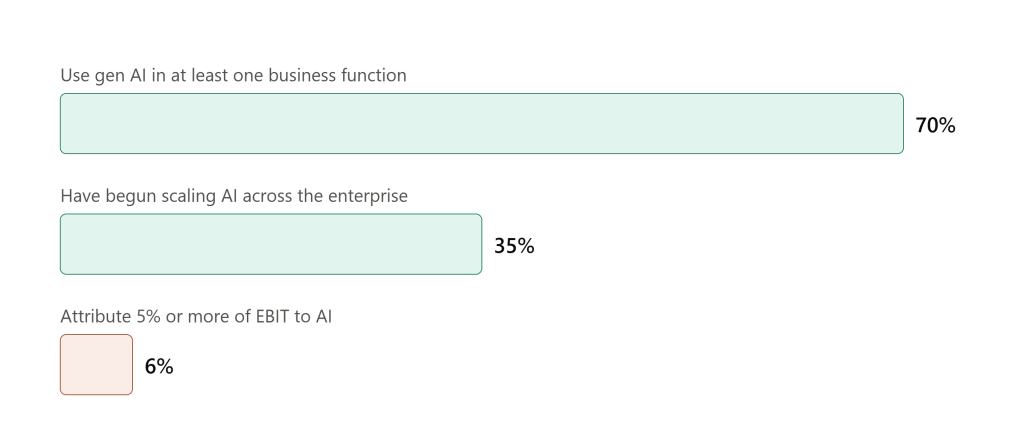
Read those three findings together and a picture emerges. The build step is now cheap, fast, and broadly solved. The scale step is where value is won or lost.
This article is about what actually changes between the two, and what to design differently if you want the second one to work.
The build phase optimises for the wrong things (and that’s fine)
A pilot exists to answer one question: is this feasible and valuable enough to continue? To answer it quickly, good teams make deliberate simplifications. They pick a clean data slice. They hardcode a connection. They evaluate on a curated set of examples. They put one skilled engineer close to the problem. They accept manual steps in the loop because the loop only runs a few hundred times.
Every one of those choices is correct in the build phase and structurally wrong in the scale phase.
| Dimension | Building | Scaling |
|---|---|---|
| Success metric | Does it work on representative examples? | Does it hold up across the full distribution, every day? |
| Data | A curated snapshot | Live, permissioned, changing, contested |
| Cost model | Rounding error | A line item with a per-transaction unit economics story |
| Failure | Annoying | Visible to customers, regulators, and auditors |
| Team | One team, one context | Many teams, shared platform, uneven skill |
| Time horizon | Weeks | Years, across model generations |
| Bottleneck | Model capability | Integration, governance, ownership, cost |
The last row is the one most programmes get wrong. Teams that stall usually respond to a scaling problem by shopping for a better model. Gartner’s analysis of agentic projects named the three drivers of cancellation as escalating costs, unclear business value, and inadequate risk controls. Model capability is not on that list. A stronger model applied to an unscoped, unowned, unmeasured workflow produces a more articulate version of the same failure.
Seven things that change when you cross the line
1. The model stops being the product
The most durable observation in this field is now over a decade old. In Hidden Technical Debt in Machine Learning Systems, a team at Google showed that the actual learning code occupies a small fraction of a real production ML system. Everything around it — configuration, data collection and verification, feature management, serving infrastructure, resource management, monitoring, analysis tooling — is the rest of the mass.
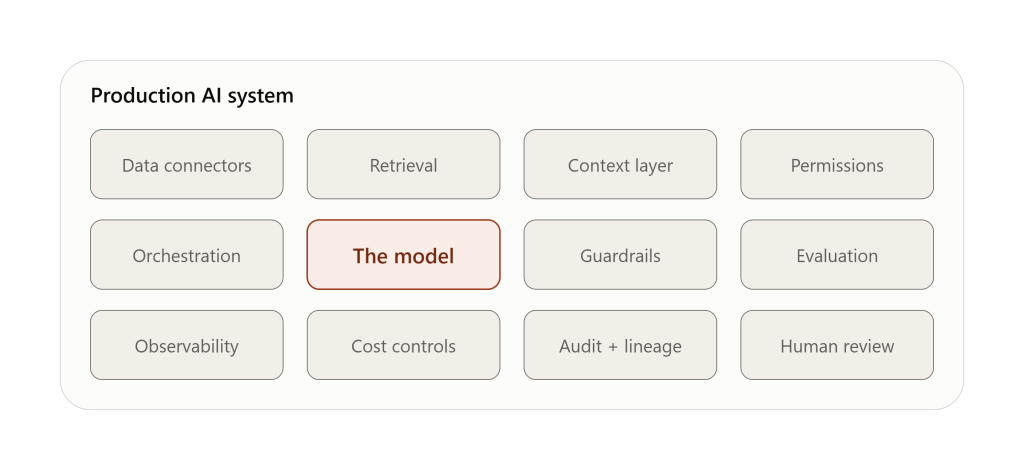
Generative AI changed the shape of that diagram but not the ratio. Swap feature stores for retrieval and context assembly, swap training pipelines for evaluation and prompt lifecycle management, add a model gateway, add guardrails, add cost controls. The proportion of work that is not “the model” stays roughly the same. Google’s own guidance on MLOps and continuous delivery states the point plainly: the hard part was never training a model with good offline performance, it was building an integrated system and operating it continuously.
What to do differently: budget the pilot as roughly 20% of the total programme, not 80%. If the business case only closes when you assume the pilot cost is the run cost, the business case does not close.
2. Evaluation moves from an event to infrastructure
In the build phase, evaluation is something you do before the demo. At scale, evaluation is a system that runs continuously, because everything underneath you moves: user behaviour, source documents, upstream schemas, policies, and the models themselves. Model versions get deprecated on the provider’s timeline, not yours. A prompt tuned against one version can degrade quietly against its successor.
Quiet degradation is the specific danger. A conventional software regression throws an error. An AI regression returns a fluent, confident, plausible answer that happens to be worse. Nothing goes red.
What to do differently: treat your evaluation set as a production asset with an owner, versioning, and a growth process that pulls in real failures from live traffic. Ship offline evals, online scoring, and a human review queue on day one of the scale phase. Set a regression gate that blocks deployment, in the same way test coverage gates code.
3. Cost becomes an architecture constraint, not an invoice
Per-token prices have fallen dramatically and keep falling. Total enterprise AI spend has risen anyway, because volume, context length, retries, and multi-step agent loops grow faster than unit prices drop. McKinsey’s 2026 data has around a fifth of respondents naming AI operating costs as an active constraint on further use.
This is why unit economics has to enter the design conversation early. The question is not “what does a million tokens cost.” It is “what does one resolved ticket, one processed claim, one completed reconciliation cost, and how does that compare to what it displaces.” At pilot volumes, nobody asks. At ten thousand transactions a day, that ratio decides whether the programme survives its next budget cycle.
What to do differently: instrument cost per outcome from the first production deployment. Design for model tiering, so the frontier model handles the 5% of cases that need it and a smaller model handles the rest. Use caching, retrieval scoping, and step limits as first-class controls. Decide deliberately where inference runs, because hardware, region, and deployment mode change both the cost curve and the data-residency story.
4. Integration depth replaces model quality as the differentiator
The recurring finding across the MIT, McKinsey, and Stanford data is that value tracks workflow integration rather than model sophistication. Pilots that sit next to the work produce enthusiasm. Systems embedded inside the work produce P&L movement.
Embedding is where the difficulty concentrates, and it is unglamorous: identity and single sign-on, role-based permissions carried through retrieval so the model can never surface what the user cannot see, connectors to systems of record, write-back with preview and approval, audit trails, human escalation paths, and the redesign of the surrounding process so that people actually stop doing the old thing.
What to do differently: choose your second use case for depth in one workflow rather than breadth across five. Depth compounds; breadth fragments.
5. Governance shifts from policy document to runtime behaviour
At pilot scale, governance is a review meeting. At production scale, it is code paths. Obligations for general-purpose AI models under the EU AI Act came into application in August 2025, with high-risk system rules following, and the extraterritorial reach means placement on the EU market matters more than headquarters location. Voluntary frameworks such as the NIST AI Risk Management Framework and its generative AI profile are increasingly the operating model organisations use to generate the evidence regulators ask for.
Evidence is the operative word. Nobody can produce a lineage record retroactively. If you cannot show which model version, which prompt, which retrieved sources, and which policy checks produced a given output, you cannot answer an audit question about it.
What to do differently: log the full decision trace by default, including source attribution. Enforce permissions at both retrieval and generation. Classify use cases by risk tier before deployment, not after an incident.
6. The organisation becomes the bottleneck
One team can hold an AI system in its head. Twenty teams cannot. Without a shared platform, each team rebuilds retrieval, evaluation, guardrails, and observability slightly differently, and the marginal cost of the tenth use case ends up higher than the first. That is the opposite of scaling.
The fix is the same pattern that worked for cloud and for CI/CD: a thin internal platform with paved paths, shared services, and a small enabling team, rather than a central group that becomes a queue. Reuse is what turns a portfolio of pilots into a compounding capability.
What to do differently: stand up the platform layer at use case three, before the sprawl. Measure time-to-first-production-deployment for a new team as a headline platform metric.
7. Agents multiply everything above
Autonomy raises the stakes on every point already listed. A single-shot assistant that is 95% reliable is useful. A ten-step agent chain at the same per-step reliability completes roughly 60% of the time, and the failures are correlated, opaque, and occasionally expensive. Add tool use and write access, and errors stop being wrong answers and start being wrong actions. Forbes’ 2026 revisit of the Gartner prediction makes the same point: the failure modes live in scoping, data access, ownership, and control, not in model capability.
What to do differently: cap iterations and token budgets. Require preview-and-approve on irreversible actions. Give every agent an owner, a kill switch, and a defined scope of authority. Measure task completion end to end, not step accuracy.
What a scale-ready architecture actually contains
Programmes that make the crossing tend to converge on a similar set of layers, whatever they call them:
- Infrastructure abstraction so workloads move across CPU, GPU, cloud, and on-premise without a rewrite, which is what preserves negotiating leverage as hardware and pricing shift.
- A model gateway providing routing, fallback, tiering, rate limits, and per-team cost attribution, so no application is hardwired to one provider.
- A context layer covering connectors, retrieval, permission enforcement, and source attribution, treated as a shared enterprise asset rather than per-project plumbing.
- Orchestration for multi-step workflows and agents, with state, retries, approvals, and human handoff.
- Evaluation and observability spanning offline suites, online quality scoring, drift detection, trace logging, and cost telemetry.
- Governance and policy enforcement applied at runtime, with audit trails, risk tiering, and access control.
- An application layer where the actual workflows live, thin because everything below it is shared.
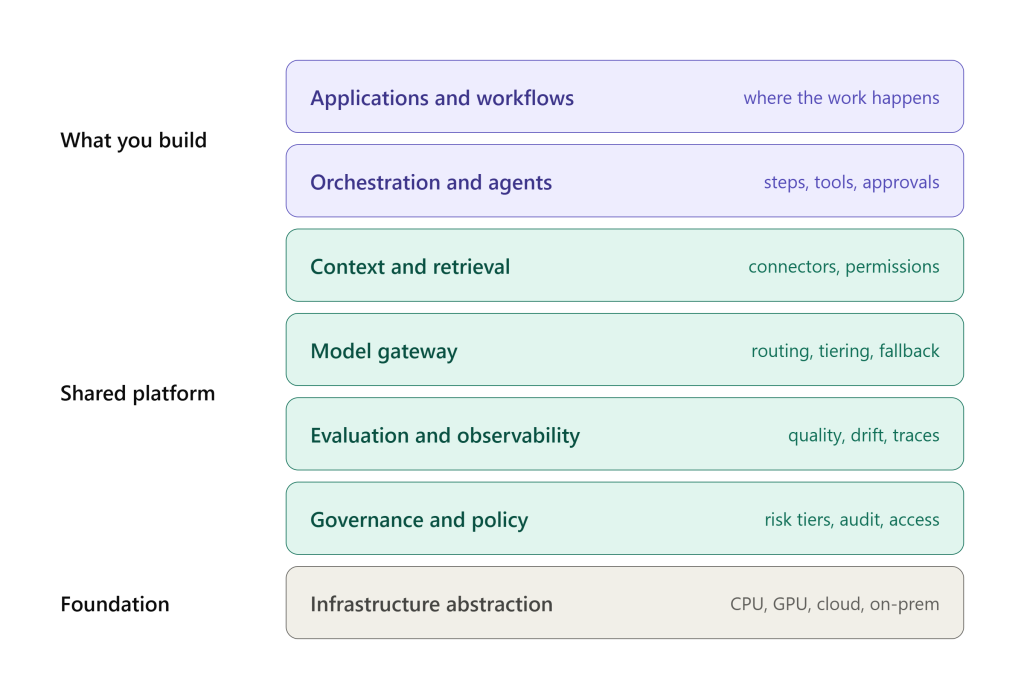
None of this is exotic. It is simply the difference between a demo and an operating capability, and it is why the second use case in a well-architected programme takes weeks while the second use case in a pilot-shaped programme takes as long as the first.
Designing pilot number one so it can survive
You can bias a pilot toward scalability without slowing it down much. Before you start, get honest answers to these:
- Which number moves, and who owns it? Name the metric and the accountable executive. Vague value is the single most reliable predictor of cancellation.
- What is the cost per outcome at 100x volume? Model it now, roughly, and check whether the ratio still works.
- Where does the data live, and who is allowed to see it? If permissions cannot be enforced at retrieval, the pilot cannot become production.
- What does failure look like, and who catches it? Define the escalation path before the first user touches the system.
- What happens when the model version changes? If the answer is “we retest by hand,” the programme does not scale past a handful of use cases.
- Which parts are reusable? Anything you would rebuild for use case two belongs in the platform, not in the application.
- What process changes for the humans involved? If the answer is nothing, expect the productivity gain to stay invisible in the P&L.
A pilot that can answer these is not slower. It is a pilot whose success means something.
The takeaway
Building AI is a modelling problem. Scaling AI is a systems, economics, governance, and organisational design problem that happens to contain a model.
The strategic implication follows directly. Model capability is converging and commoditising. Your competitive position will not come from having access to a better model, because your competitors have the same access. It will come from the layer underneath: how cleanly your data and permissions are wired, how fast you can prove a new use case works and keep proving it, how cheaply you run inference, and how quickly the tenth deployment ships compared to the first.
That layer is the actual asset. It is also the part nobody can buy off the shelf in finished form.
Accubits works with enterprises on both sides of this line — designing and building AI solutions, and engineering the platform, evaluation, cost, and governance foundations that let them run at scale. If your organisation has pilots that work and a scaling story that doesn’t yet, talk to our team about an architecture and readiness review.